Signals
What does each quantum architecture depend on? A map of critical-material dependencies
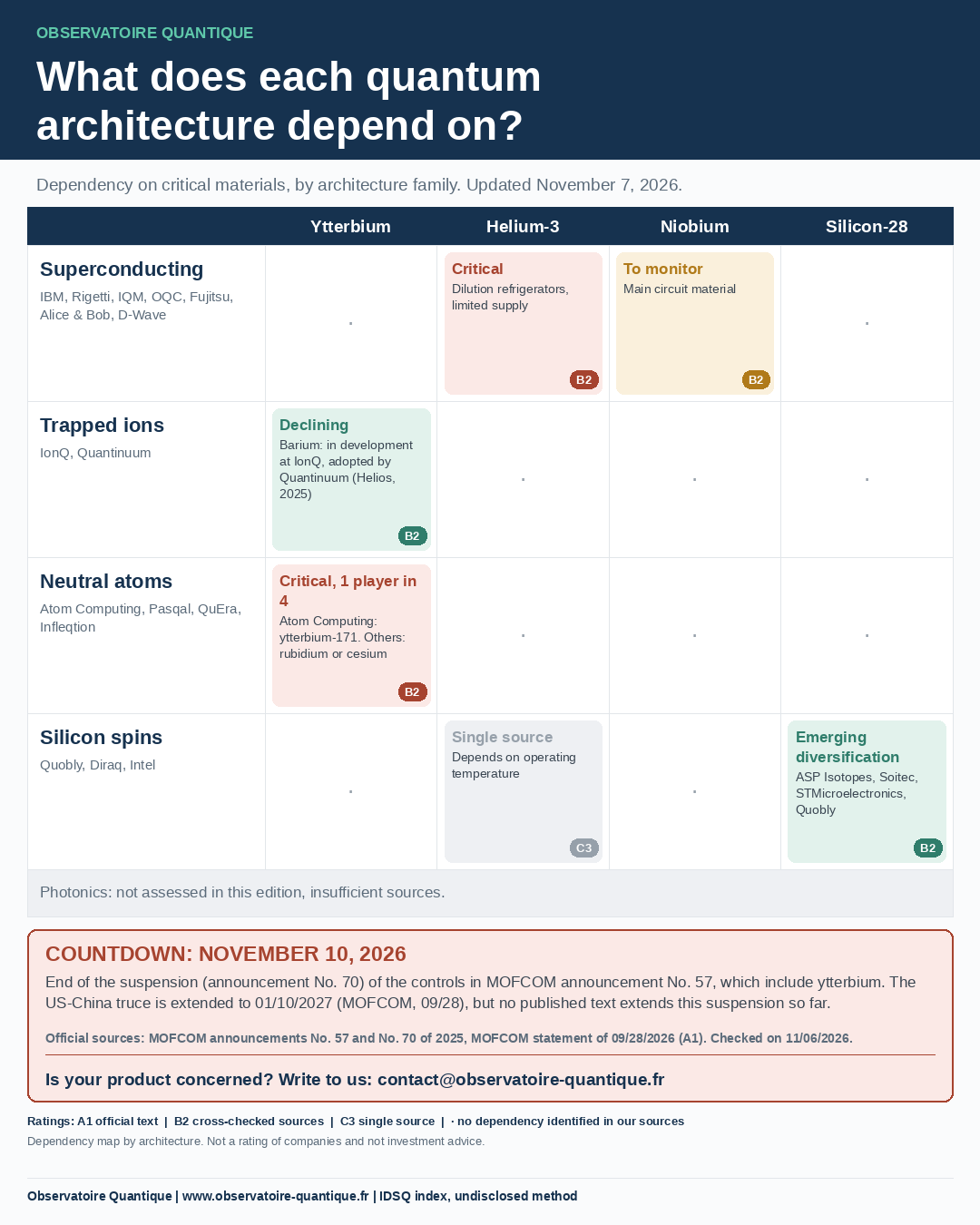
This map crosses four quantum architecture families with four critical materials. Each cell carries an evidence rating: A1 official text, B2 cross-checked sources, C3 single source. Photonics is not assessed in this edition due to insufficient sources.
| Architecture | Ytterbium | Helium-3 | Niobium | Silicon-28 |
|---|---|---|---|---|
| Superconducting (IBM, Rigetti, IQM, OQC, Fujitsu, Alice & Bob, D-Wave) | No dependency identified in our sources | Critical (B2): dilution refrigerators, limited supply | To watch (B2): main circuit material | No dependency identified |
| Trapped ions (IonQ, Quantinuum) | Declining (B2): barium in development at IonQ, adopted by Quantinuum (Helios, 2025) | No dependency identified | No dependency identified | No dependency identified |
| Neutral atoms (Atom Computing, Pasqal, QuEra, Infleqtion) | Critical for 1 player out of 4 (B2): Atom Computing uses ytterbium-171, the others rubidium or cesium | No dependency identified | No dependency identified | No dependency identified |
| Silicon spin (Quobly, Diraq, Intel) | No dependency identified | Single source (C3): depends on operating temperature | No dependency identified | Emerging diversification (B2): ASP Isotopes, Soitec, STMicroelectronics, Quobly |
| Photonics | Not assessed in this edition, insufficient sources |
Helium-3 for silicon: Quobly's sources (press releases and a conference abstract co-authored by its staff) describe on its development platform a helium-3 cooler for the 500 mK stage, and operation at 1 K with helium-4. This holds for that player only.
Rubidium, outside the map: according to the USGS (February 2026), no rubidium mine production was reported worldwide in 2025, and refining is estimated to take place in China and Germany from stockpiles. Rubidium is not in Annex II of the EU Critical Raw Materials Act, which lists 34 materials.
China's deadline, checked on November 6, 2026: MOFCOM and Customs announcement No. 70 of 2025 suspends announcements No. 55, 56, 57, 58, 61 and 62 until November 10, 2026. Ytterbium is in announcement No. 57 (code 1C913). The US-China truce was extended to January 10, 2027 according to a ministry statement of September 28, 2026, which does not name rare earths: no published text extends this suspension so far. The general dual-use licensing regime still applies.
Sources: MOFCOM and Customs announcement No. 70 of 2025 ; announcement No. 57 as reproduced by Xinhua ; Ministry of Commerce statement of 09/28/2026 ; USGS, rubidium 2026